Call for Proposals for Feasibility Studies (FS) for Research Projects For Studies Commencing in April 2027
Those considering applying are required to review the application guidelines and watch the application explanatory video described in Ⅵ-6.
Please apply to watch the application explanatory video via this link.
Ⅰ.Establishment, Vision and Mission of RIHN
The Research Institute for Humanity and Nature (hereinafter “RIHN”) was established in 2001 as an Inter-University Research Institute, with the aim of conducting integrative research in global environmental studies. It was established as a national core research institution promoting academic research in response to the needs of researchers affiliated with universities and other research institutions throughout Japan (the research community), while also pursuing collaboration with researchers overseas
Even today, the global environment faces an increasing number of problems on a planetary scale, as is evident from the fact that many indicators concerning the Earth system and socioeconomic conditions show that limits have been exceeded. Resolving global environmental problems requires not only a broad understanding of the complex natural environment, but also questioning ways of human life themselves and forms of society that would substantially transform people’s lives. Research that explores pathways towards solutions together with society is also necessary. Since its establishment, RIHN has pursued such integrative research on the global environment, which requires drawing together human wisdom without being constrained by disciplinary boundaries, under the name “Integrative Global Environmental Studies.”
Based on this understanding, RIHN’s long-term vision is to contribute to the realization of an equitable, fair and sustainable society globally by conducting research that explores how the relationship between people and nature ought to be, from the community to the global scale, and the pathways towards realizing it.
During the Fifth Mid-Term Objectives and Mid-term Plan period (FY2028–FY2033: hereinafter “Phase 5”), RIHN’s mission, as an Inter-University Research Institute, is to lead integrative research in global environmental studies that seeks a fundamental and comprehensive understanding of the cycles of interaction between humans and nature and explores pathways towards resolving global environmental problems. This is to be achieved by providing research infrastructure and systems that individual universities cannot establish on their own, through interdisciplinary research integrating the humanities, social sciences and natural sciences, as well as transdisciplinary research undertaken in collaboration and cooperation with society.
Ⅱ.Feasibility Studies (FS) Offered in This Call
The “Feasibility Studies (FS)” offered through this call are preliminary studies to be undertaken by researchers who intend subsequently to conduct project-based research at RIHN as “Full Research (FR).” Resolving global environmental problems requires both a broad understanding of the natural environment and a comprehensive reconsideration of human ways of life and the nature of society; these problems cannot, in our view, be addressed by a single academic discipline. Accordingly, it is essential that the FS offered in this call be conducted as “interdisciplinary research” extending beyond the academic field of the principal investigator’s own specialization.
Furthermore, progress towards actually resolving global environmental problems is difficult through research confined to academia alone; research with stakeholders is also necessary. Research undertaken in collaboration and cooperation with society is called “transdisciplinary research,” and including this approach is also an element of integrative research at RIHN.
At the FS stage, in addition to the research theme and content, we will evaluate whether applicants are prepared to undertake preliminary research incorporating elements of both “interdisciplinary research” and “transdisciplinary research,” as a precursor to the integrative research to be conducted in FR. Starting with this call, Phase 5 FS are being solicited as “Integrated Projects,” please read Section III, “Integrated Project System in the Phase 5,” carefully when preparing your research plan.
RIHN has previously invited proposals for Incubation Studies (IS), which precede the FS stage, with the aim of further advancing interdisciplinary and transdisciplinary research. However, in light of the increasing maturity of research proposals in recent years, RIHN will invite proposals for FS only from this call onward.
In addition, to ensure sufficient time for research during the FS stage, the FS period in Phase 5 will, in principle, be 18 months. As an exception, however, the FS selected through this first call will run for one year, from April 2027 to March 2028.
Ⅲ.Integrated Project System in the Phase 5
1.Integrated Project System
During the Third Mid-Term Objectives and Mid-term Plan Period (FY2016–FY2021: Phase 3), RIHN introduced a “Program–Project System,” in which research projects were carried out under programs bringing together work across existing academic disciplines and fields. Furthermore, during the Fourth Mid-Term Objectives and Mid-term Plan Period (FY2022–FY2027: Phase 4), three programs formulated clearly defined missions based on their research themes and implemented research projects in accordance with those missions.
In the forthcoming Phase 5 (FY2028–FY2033), RIHN will develop and integrate the knowledge gained through the Program–Project System implemented in the Phase 3 and 4, further strengthen collaboration and cooperation, and implement an “Integrated Project System” aimed at the integration of global environmental research.
Under the Integrated Project System, RIHN will solicit research projects on the basis of its mission and the “Three Perspectives” required of Phase 5 research projects, without requiring affiliation with any particular program of the kind operated during the Phase 3 and 4.
2.Three Perspectives
Under Phase 5, research projects are expected to make the fullest use of the Principal Investigator’s expertise and originality while contributing to the advancement of RIHN’s research objectives. To this end, projects should be conceived and implemented with due consideration of the importance of the following three perspectives and should incorporate all three.
The three perspectives address the relationship between humans and nature from different dimensions and are strongly complementary. Through the interplay and integration of these perspectives, RIHN aims to deepen our understanding of global environmental issues, generate new knowledge toward their resolution, and explore ways of addressing them.
While the relative emphasis placed on each perspective may vary depending on the distinctive characteristics of individual projects, research plans are expected to establish meaningful connections among all three perspectives and actively engage across them.
Through such an approach, RIHN seeks not only to open up new horizons within each perspective, but also to integrate insights from all three, thereby pioneering new frontiers in global environmental studies.
The first perspective is an Earth-system perspective: it takes an overarching view of the Earth, in which humans and nature interact, as a single system; identifies compound risks and their underlying contexts; clarifies the trade-offs and synergies arising among them; and explores what a sustainable Earth might be like.
The second perspective is an endogenous perspective: it understands the relationship between humans and nature in the context of individuals and communities living in particular local settings, and explores the underlying “ways of human life,” “values,” and “worldviews.”
The third perspective is a perspective of societal response: it explores the social mechanisms that support the reconciliation of values and interests among diverse actors concerning the relationships between humans and nature across different spatial and temporal scales, as well as society’s capacity to establish and renew those mechanisms.
Explanations intended to aid understanding of the three perspectives are provided below for reference.
First Perspective
Human society exists in mutual dependence with the Earth system, which encompasses climate, ecosystems, water, food, resources and energy. In the Anthropocene, changes in these elements are interconnected and generate compound risks that propagate across regions and domains. It is therefore necessary to understand humans and nature, society and ecosystems, and the present and future as mutually interconnected systems, rather than treating individual environmental problems independently. At the same time, it is important to consider not only risks that should be avoided, but also possibilities for the future in terms of what should be protected, nurtured and created for human society and diverse forms of life.
On this basis, this perspective identifies trade-offs among different issues and goals and explores the possibility of synergies through which multiple goals can be achieved together. Furthermore, it examines changes in the Earth system and transformations of human society across multiple spatial and temporal scales, from local to global and from the present to the future. Through such Earth-system thinking, it presents pathways towards answering the question: “What should a sustainable global society, in harmony with the dynamics of the Earth system, be like?”
Second Perspective
Global environmental problems need to be understood not only from a macro-level perspective but also as issues specific to each society, in accordance with its distinctive historical and cultural context. This is because the relationships between humans and nature are sustained by plural values that differ among regions and are deeply connected with changes in people’s awareness and behavior. This “endogenous perspective” encompasses complex and plural worlds that include supernatural beings, non-human species and material things. It is also directly connected to questions cultivated within different cultures, such as “What are human beings?” and “How should we live?” It therefore plays an important role in enabling people to recognize global environmental problems as issues directly connected to their own lived worlds and in guiding changes in behavior.
The endogenous perspective is nothing other than the “wisdom particular to each society” that people have generated while grappling with challenges in their respective settings. Combining this wisdom with diverse forms of knowledge from outside can give rise to the creativity needed to resolve unprecedented global environmental problems. In this way, the endogenous perspective presents pathways towards answering the fundamental question now posed to us: “How should people live?”
Third Perspective
Individuals and communities are situated within multilayered relationships at regional, national and international levels, and institutions, policies and norms have developed in these various settings to reconcile diverse values and interests, allocate resources and establish new rules. However, in the Anthropocene, when challenges arising from climate change, biodiversity loss and other causes are intricately interconnected and cut across multiple spatial and temporal scales from the local to the global, existing mechanisms for reconciling values are becoming increasingly inadequate.
For this reason, the transition or transformation towards a sustainable society needs to be understood not as the construction of a single solution or mechanism for reconciling values, but as a social process in which diverse actors continually engage in dialogue, learning and the reconciliation of values while taking account of different values and systems of knowledge. In this context, it is important both to co-create knowledge through dialogue on an equal footing among researchers, citizens, public administrations, businesses, NPOs and international organizations, and to adopt an interdisciplinary perspective that integrates diverse scientific knowledge. In this way, the perspective of societal response presents pathways towards answering the question: “How are social mechanisms and capacities formed that enable solutions to be continuously created and renewed in response to environmental and social changes?”
3.Research Coordination
During the FS period, RIHN’s internal Project Development Working Group will provide research coordination in terms of both consistency with RIHN’s mission and the maturity of the research. After the FS begins, workshops on RIHN’s mission and presentations by each FS and exchanges of views will be organized. Where necessary, and with the agreement of the principal investigator, researchers from within or outside RIHN may be appointed as advisers. Research coordination will respect the autonomy of research projects and will be conducted separately from screening and evaluation.
Ⅳ.What Is a Research Project?
1.Characteristics of Research Projects
RIHN is one of the “Inter-University Research Institutes” established as national core research institutions to promote academic research in response to the needs of relevant researchers (the research community) at universities and other research institutions throughout Japan, while also collaborating widely with researchers overseas. RIHN research projects are implemented as collaborative research projects funded by the operating expense grants allocated to Inter-University Research Institutes. They differ in nature, and particularly in organizational structure, from collaborative research funded by Grants-in-Aid for Scientific Research (KAKENHI) and similar schemes.
RIHN’s research projects are characterized by a system in which researchers from different fields conduct research in collaboration with society and, through internal screening and external evaluation, progressively deepen and refine the research content. FS is preparatory research necessary for carrying out FR, and projects are required to undergo screening to advance to the next stage before transitioning to FR.
Once the transition from FS to FR has been approved, the personnel costs of the Project Leader (PL) are covered not by the project budget but by RIHN’s operating expense grants, and the PL must be employed by RIHN as a professor or associate professor. This is because RIHN aims for its research projects, which form the core of its research, to generate new ideas and exchanges by conducting research across disciplines in RIHN as the “platform”.
Accordingly, once a research project has been selected, the PL will, through a complete transfer to RIHN or application of a cross-appointment arrangement, conduct collaborative research at RIHN with external collaborative researchers as a RIHN faculty member throughout the FR implementation period.
Furthermore, unlike funding systems such as KAKENHI, RIHN consistently manages and executes budgets from FS through FR. Therefore, research funds are not allocated to the institutions to which FS principal investigators or collaborative researchers belong.
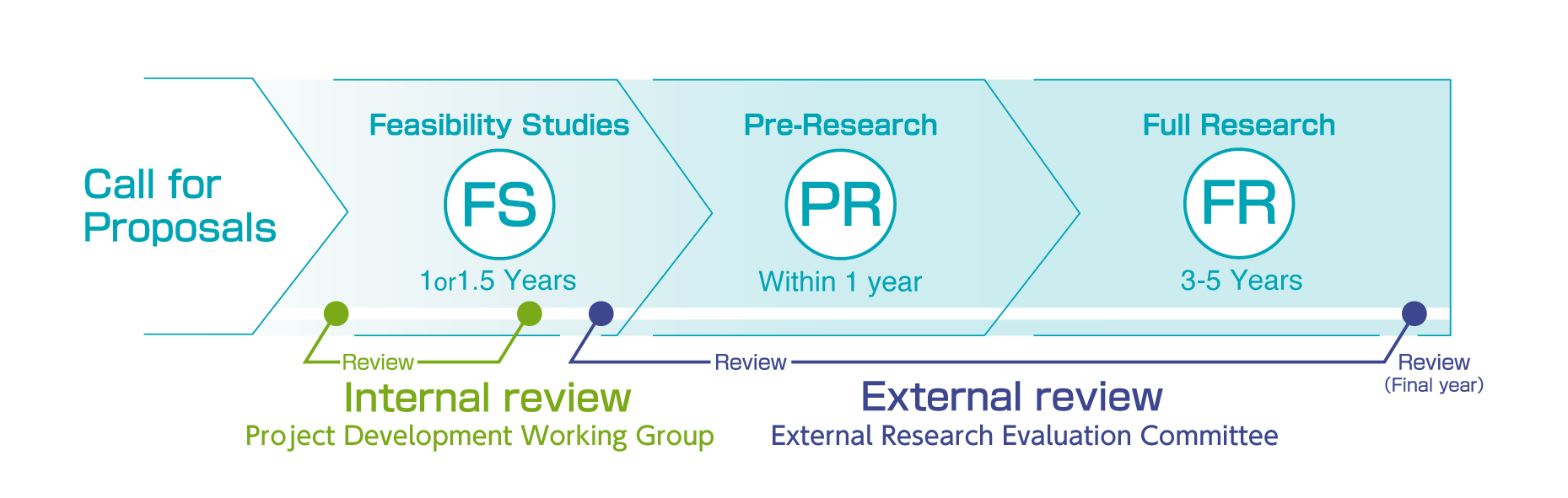
2.Research Project Development Process (Starting in April 2027)
| Research Phase | Outline |
|---|---|
| Feasibility Study (FS) Research period: 1 year Maximum budget: JPY 4 million per year Principal investigators are to be appointed as RIHN Specially Appointed Visiting Faculty Members. |
FS is preliminary collaborative research undertaken to test feasibility as FR. During FS, the principal investigator must become a Specially Appointed Visiting Faculty Member at RIHN. The principal investigator must be able to continue leading the research as the person responsible from the start of FS to the end of FR.
FS is a preparatory research stage for FR, and all FSs are subject to review for progression to FR. Applications intended to conduct FS only without proceeding to FR, are not eligible.
Under Phase 5, FS projects will normally begin in October and run for 18 months. As a transitional arrangement, however, only the FS projects covered by this call will begin in April and have a one-year duration. |
| Pre-Research (PR) Research period: within 1 year Maximum budget: JPY 16 million per year (prorated by month if shorter than one year) Principal investigators are to be hired as RIHN faculty members. |
After the transition to FR has been approved, a preparatory period of up to one year may be provided. During this period, preparations such as setting up the project room and open recruitment of research staff are undertaken to enable research to start smoothly from the beginning of FR.
Because transition to and commencement of FR are limited to April of each fiscal year, research continues as an extended FS between approval of transition and employment of the PL. Between the start of employment and commencement of FR in April, preparations for FR are undertaken as PR. PR is not mandatory, but most projects selected for FR have undertaken PR of up to one year. |
| Full Research (FR) Research period: 3-5 years Maximum budget: JPY 60 million per year Principal investigators are to be hired as RIHN faculty members. |
FR is a period of long-term collaborative research. As a RIHN professor or associate professor, the PL is responsible for implementing project research.
Research projects must be carried out with collaborative researchers who participate in and jointly conduct the research. These may include researchers affiliated with universities or other research institutions, graduate students, and others whom the PL considers necessary and whose participation is approved. Since the budget is executed at RIHN, research funds are not allocated to collaborative researchers; however, expenses necessary for research activities, including travel and purchases of goods, may be used. Numbers vary by project, ranging from more than 100 collaborative researchers in larger projects to approximately 20–30 in smaller ones. |
3.Project Leaders (PLs)
As noted above, a distinctive feature of RIHN research projects is that the PL is employed at RIHN using RIHN’s budget, while research and administrative staff are employed at RIHN using the project budget, and research is conducted with external collaborative researchers, with RIHN as the “platform” for the research.
If a research proposal is selected as a RIHN research project, the PL must be employed by RIHN as a professor or associate professor, either through a complete transfer to RIHN or through a cross-appointment arrangement. In either case, RIHN and the institution to which the principal investigator belongs will consult fully on recruitment and other personnel procedures and, where necessary, set out arrangements in a collaboration agreement, memorandum of understanding or similar document.
Applicants planning to use a cross-appointment arrangement must consult their home institution and indicate the percentage of effort to be devoted to RIHN duties by the internal screening in November for transition from FS to FR. In keeping with its policy of having PLs devote themselves to RIHN duties to the greatest extent possible, RIHN requires that the proportion of effort devoted to RIHN duties (including attendance at internal meetings) under a cross-appointment arrangement be at least 70%. The principal investigator is expected to be able to discharge the responsibilities of the person in charge throughout the entire period from the beginning of FS to the end of FR. Accordingly, replacement of the principal investigator during the research implementation period is not envisaged.
The most important duty of a Project Leader is to implement the project. However, because PLs are not merely joint users of RIHN but also faculty members who support RIHN as an Inter-University Research Institute, they are expected, after FR begins, to participate proactively in RIHN’s educational, administrative and management duties and in various events. They are also expected to undertake educational activities in the Global Environmental Studies Program (doctoral program only) of the Graduate University for Advanced Studies (SOKENDAI), which is established at RIHN.
Ⅴ.Screening and Evaluation of Research Projects
1.Internal Screening and External Evaluation
RIHN selects research projects reflecting the intentions of the academic community and the latest research trends.
Internal screening for the selection of FS and for referral to external evaluation in connection with transition to FR is conducted by the Project Development Working Group. In addition, transition from FS to FR is subject to external evaluation by the External Research Evaluation Committee (EREC), whose members are all external experts and of whom a majority are based overseas.
If selected for FS, applicants must present an FS report and a plan for transition to FR at internal screening in November 2027. Following screening by the Project Development Working Group, they will proceed to external evaluation in February 2028. Because the selection of preparatory studies and the formation of research projects are undertaken on the premise that FR will be implemented in the future, all FS must undergo screening for transition to FR.
2.Selection Criteria
Please refer to the following criteria required of research projects.
Selection criteria
| 1. Inclusion of the Three Perspectives |
-The project engages all three perspectives significant to the mission of the Phase 5 |
| 2. Problem to be addressed, Background |
-The research will address a significant sustainability challenge in concrete way -The relevant academic literature is reviewed in relation to the proposed research -The societal context and significance of the research is explicitly discussed
|
| 3. Originality |
-The novelty of the proposed study in relation to existing research is clearly described |
| 4. International Relevance |
-The study includes meaningful work in multiple countries and regions, and/or demonstrates the international relevance of its approach and findings, including links to international processes |
| 5. Interdisciplinarity |
-Project organization is not based solely on disciplinary groups -Specific research corresponds to an integrated conceptualization of the overarching research questions
|
| 6. Transdisciplinarity |
-Co-designed with stakeholders/integration of different realms of knowledge -Clear indication of how the project contributes to real-world change
|
Required conditions
| 1. Appropriateness of the Research Proposal |
1. Project Leader Qualifications
2. Appropriateness of Methodology |
| 2. Sound Project Design |
1. Appropriate Project Structure
2. Feasibility of the Plan |
Ⅵ.Application Procedures
1. Documents to Be Submitted
After reviewing the notes in the application form, please submit the following documents:
(1) Forms 1-7a(word/pdf) or 1-7b(word/pdf): Application Form for Feasibility Study (FS) Starting in April 2027
Form 7a is for applicants from outside RIHN and Form 7b is for applicants within RIHN; only the section concerning the letter of consent differs.
(2) Form 1-8: Research Plan for Feasibility Study (FS) Starting in April 2027(word/pdf)
(3) Applicant’s curriculum vitae(word/pdf)
(4) Names and contact details of two persons able to provide references (only for applicants falling under item (2) of “2. Eligibility”).
2. Eligibility
Applicants must satisfy either (1) or (2) and also (3), and must be able to serve as the project representative and continuously lead the research project from the start of the FS through the completion of the FR.
(1) Professors, associate professors, lecturers and assistant professors at national, public or private universities and similar institutions.
(2) Persons with qualifications equivalent to those specified in the preceding item. In this case, please submit the names, affiliations, telephone numbers and email addresses of two persons who can provide references concerning the applicant.
(3) Persons who have not reached the age of 65 as of March 31 of the fiscal year preceding the fiscal year in which FR is to commence (including an anticipated commencement year).
Note: The National Institutes for the Humanities sets the retirement age at 65. The retirement date is the first March 31 following the date on which an employee reaches retirement age, and employment does not continue into the following fiscal year or thereafter. If a person has reached the age of 65 as of March 31 of the fiscal year preceding the fiscal year in which FR commences, an employment contract cannot be concluded in the FR commencement year, and that person cannot serve as an FR Project Leader. Details of arrangements where a person may reach retirement age after FR has begun will be explained at the consultation sessions.
Note: For fixed-term employees, the total period of employment as professors and associate professors serving as Project Leaders under fixed-term employment contracts with the National Institutes for the Humanities may not exceed 10 years. For contracts commencing on or after April 1, 2013, any period of employment prior to a break of six months or longer is excluded from the calculation of the 10-year limit, provided that the previous contract had expired before the break.
3. Research Period
From April 1, 2027 to March 31, 2028.
4. Budget Plan
RIHN will cover travel expenses, consumables and similar expenses within the available budget. Please prepare a budget plan not exceeding JPY 4 million. For eligible expenditure items, please consult “Notes on Preparing the FS Research Plan” at the end of the form. During the FS period, items costing JPY 100,000 or more per unit and having a useful life exceeding one year may not be purchased.
5. Submission Deadline and Method
Submission Deadline:
Thursday, January 7, 2027, 10:00 a.m. (Japan Standard Time, JST).
Applications must be received by this deadline.
Submission method: Please submit by email or post.
Email: opencall[at]chikyu.ac.jp (replace [at] with @).
Postal address: Research Planning Subsection, Research Support Section, Administrative Office, Research Institute for Humanity and Nature, 457-4 Motoyama, Kamigamo, Kita-ku, Kyoto 603-8047, Japan.
・ The subject line of the application email should be “[FY2027 FS Call for Proposals] Your name”.
・ An acknowledgement email will be sent after receipt of an email application. If you have not received an acknowledgement by 1:00 p.m. on Friday, January 8, please inquire.
・ Please scan Form 1-7 bearing an official seal and submit it as a PDF attachment to an email. There is no need to post the original paper document.
6. Explanatory Video and Online Consultation Sessions
If you are interested in applying, please be sure to watch the explanatory video. Please register here to watch the Explanatory Video.
A link to the video in either Japanese or English will be sent to you.
Online consultation sessions on the Call for Proposals for non-Japanese speakers will be held in English on the dates listed below. If you would like to participate, please register in advance. Information on how to join the sessions will be provided when the link to the explanatory video is sent to you.
Session1: December 8 (Tue.) 10:00-11:00 a.m. JST
Session2: December 9 (Wed.) 4:00-5:00 p.m. JST
To ensure fairness, the questions received and the corresponding answers will be summarized in a general form that does not identify individual cases and published on the RIHN website.
Note: We will not answer questions regarding the likelihood of acceptance or rejection of particular proposals or any questions that could affect their evaluation during the screening process.
7. Key Dates
| Timing | Procedure / Event |
|---|---|
| December 8 (Tue.) and 9 (Wed.), 2026 |
Online consultation sessions |
| January 7, 2027 (Thu.) |
Deadline for submitting application documents |
| Late-January, 2027 |
Notification of document-screening results |
| February 16, 2027 (Tue.) Reserve date*: February 17 (Wed.) |
Presentation screening of proposals that pass document screening. * A reserve date is an alternative date to be used, for example, if screening cannot be completed on the initially scheduled date owing to a large number of applications or other reasons. |
| April 1, 2027(Thu.) | Commencement of the FS |
| November 16, 2027 (tentative) | Internal screening for transition to FR |
| Early February 2028 | External evaluation by the External Research Evaluation Committee (EREC) |
| Late February to March 2028 | Internal deliberation and decision concerning selection for FR |
| From April 2028 onward | PR begins as necessary after completion of PL employment procedures. * If employment can commence in April and PR is not undertaken, FR begins. |
8. Reference Materials
When preparing the application form, please refer to the following RIHN webpages.
Please note that some regulations are scheduled to be revised on December 1. Applicants are kindly requested to check the relevant regulations on or after that date.
- RIHN Philosophy and Goals:
https://www.chikyu.ac.jp/rihn_e/about/philosophy/ - Research Institute for Humanity and Nature Brochure:
https://www.chikyu.ac.jp/rihn_e/publicity/brochure/ - RIHN Research Project Regulations: (Available from December 1)
- Detailed Rules for Implementation of RIHN Research Projects and Related Activities: (Available from December 1)
9. Notes
- Submission documents must be prepared in Japanese or English.
- The language used in the presentation screening after passing document screening may be Japanese or English. Applicants must bear their own travel expenses to attend.
- The language used at the internal review may be Japanese or English; the language used at meetings of the EREC is English.
- As a general rule, presentations at screening and evaluation must be given by the principal investigator at the respective presentation venue.
- The next FS call is expected around May 2027, with selected projects commencing in October 2027 and running for 18 months.
【Inquiries】
Research Planning Subsection, Research Support Division, Administrative Office, Research Institute for Humanity and Nature
Telephone: +81-(0)75-707-2148
Email: opencall[at]chikyu.ac.jp (replace [at] with @).
Frequently Asked Questions (FAQ)
Q1 .
Must a proposal already constitute interdisciplinary and transdisciplinary research at the FS application stage?
A1.
At the time of an FS proposal, the research theme must be framed as interdisciplinary and transdisciplinary research with FR in view. However, FS is a preparatory stage, and the maturity of the research as transdisciplinary research is expected to develop gradually.
Q2.
Can the research project budget be allocated as shared contributions to the institutions of the principal investigator or collaborative researchers?
A2.
Research projects are implemented using RIHN’s operating expense grants. Unlike budgets from competitive research funding agencies, these funds cannot be allocated as shared contributions to other universities or research institutions.
Q3.
What administrative and management duties are expected of a PL?
A3.
These are expected to include participation in monthly faculty meetings (except in August), participation in various committees and working groups, and associated duties.
Q4.
I wish to use a cross-appointment arrangement. If the university or other research institution to which I belong specifies an effort allocation, may the proportion of effort devoted to RIHN be below 70%?
A4.
The proportion of effort devoted to RIHN is set at 70% or more. Within this range, details will be coordinated individually with the applicant’s university or other research institution. When publishing papers or other research outputs, RIHN must also be indicated as the primary institutional affiliation (other affiliations may be listed in addition).
Q5.
What is the status of collaborative researchers?
A5.
Collaborative researchers are research project members who participate in a research project and conduct research jointly. They include researchers affiliated with universities or other research institutions, graduate students, and others whom the Project Leader considers necessary and whose participation is approved. Research funds cannot be allocated to collaborative researchers, nor can honoraria be paid to them; however, expenses necessary for research activities, including travel and purchases of goods, may be used.