Co-creation of the Earth-human System Program
Sustai-N-able (SusN) Project
Towards Sustainable Nitrogen Use Connecting Human Society and Nature
Abstract
Nitrogen provides great benefits to humankind as a fertilizer, industrial material and fuel. However, our use of nitrogen unintentionally causes nitrogen pollution and threatens the health of humans and nature. In this project, we will elucidate the dynamics of nitrogen, of which much remains unknown; quantify the environmental burden and impact of nitrogen use; evaluate its benefits and threats and the effects of countermeasures and behavior change; and design the future to realize sustainable nitrogen use.
Sustai-N-able Project web site
Nitrogen is an essential element for creating proteins, nucleobases, and other biomolecules. Although nitrogen is ubiquitous, with 78% of the earth’s atmosphere being nitrogen gas (N2), most living organisms, including humans, do not have access to stable N2 and require a form of nitrogen other than N2 (reactive nitrogen, Nr). Our diet is also a means of obtaining nitrogen in the form of protein. To get more food from limited land, we need Nr as fertilizer, and ammonia synthesis technology (Haber-Bosch process), developed in the early 20th century, made it possible to obtain as much Nr as desired.
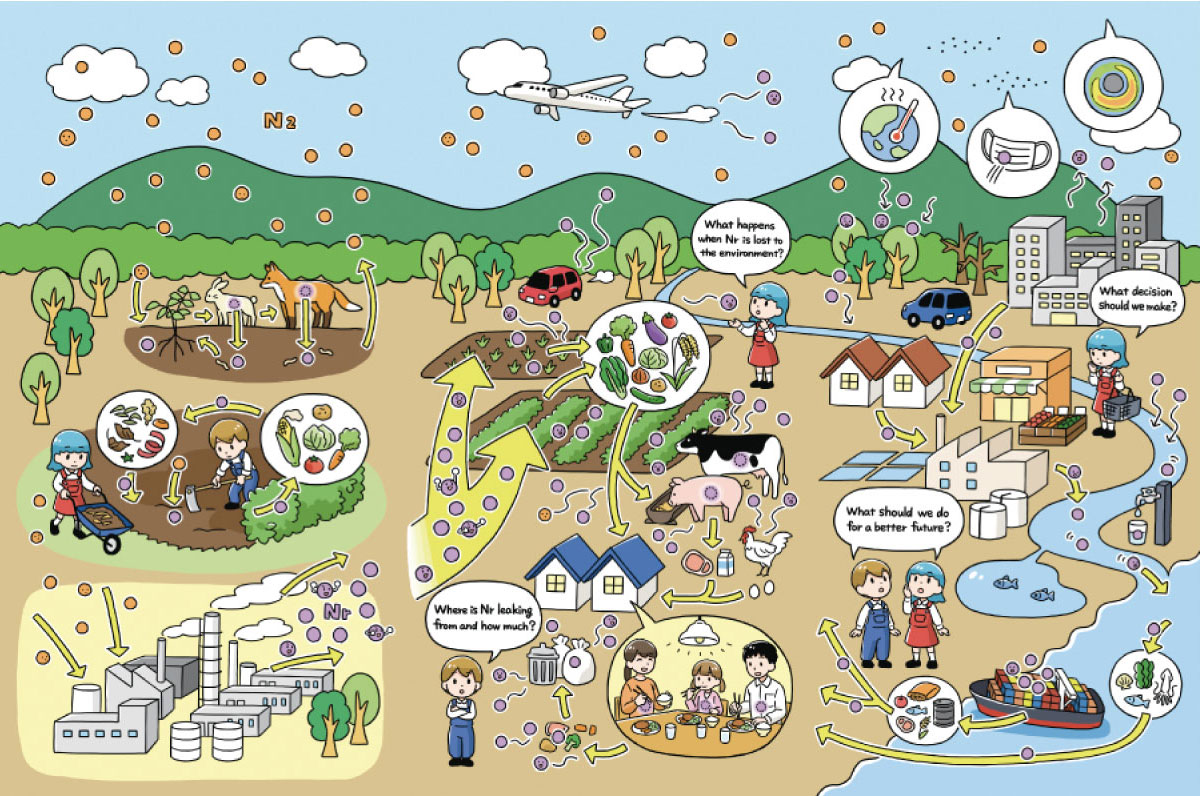
Synthesized Nr has been used as an industrial raw material as well as a fertilizer, providing a great benefit to mankind. On the other hand, much of the Nr used by humans is discharged into the environment along with its reactive properties. This is especially due to the low nitrogen use efficiency (NUE) of the food system. In addition to the low NUE of food production, there are consumption challenges such as food loss and a preference for livestock products with relatively low NUE. Combustion of fossil fuels and others is another source of Nr emissions.
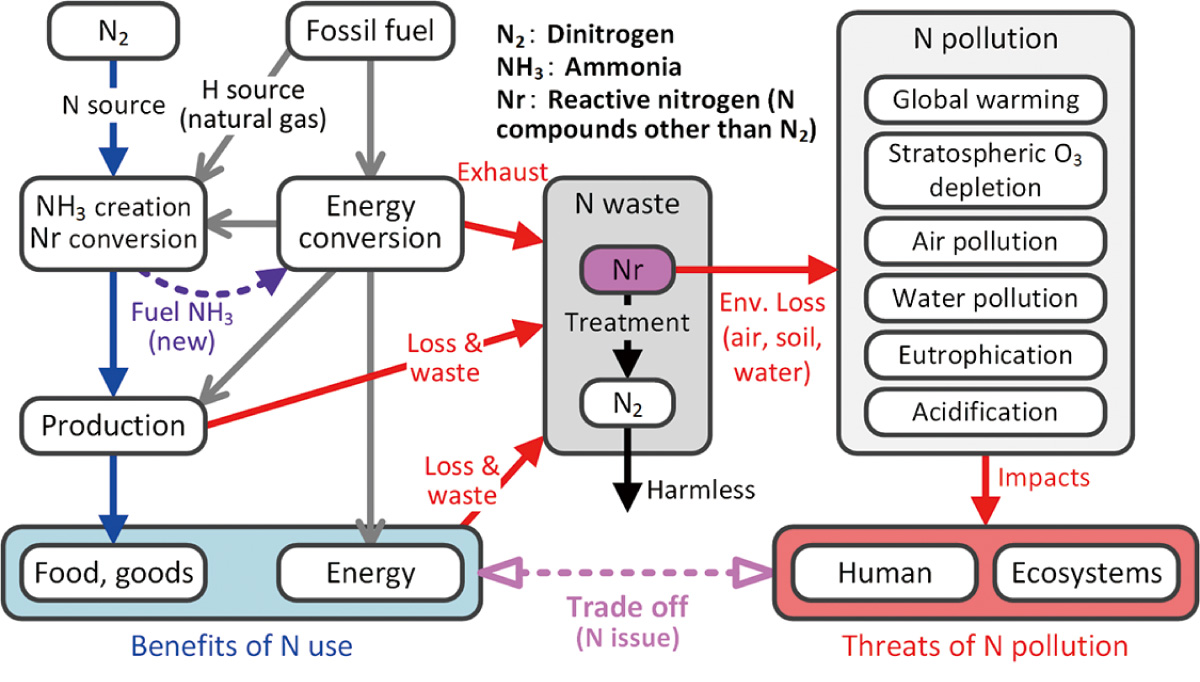
As a result of Nr emissions into the environment, various forms of nitrogen pollution such as global warming, stratospheric ozone depletion, air pollution, water pollution, eutrophication, and acidification have occurred, causing damage to human and natural health. The trade-off between the benefits of nitrogen use with the threat of nitrogen pollution is called the “nitrogen issue” (Figure 1). To ensure that our future possibilities are sound, we conduct this research to gain integrated knowledge that will lead to solutions to the nitrogen issue and sustainable nitrogen use for future generations.
Results
What we know so far
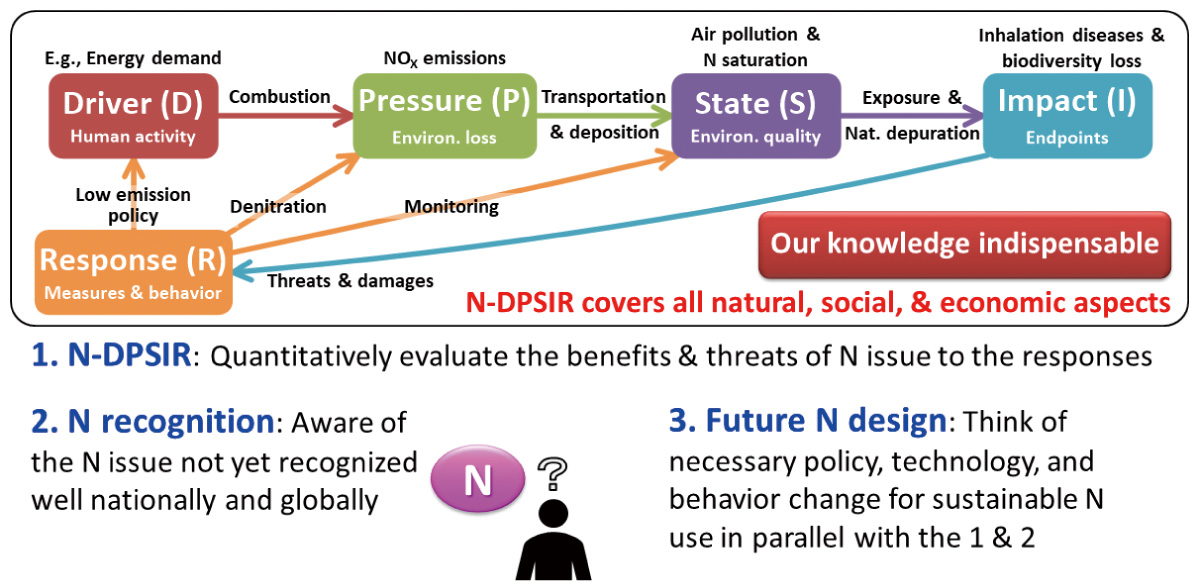
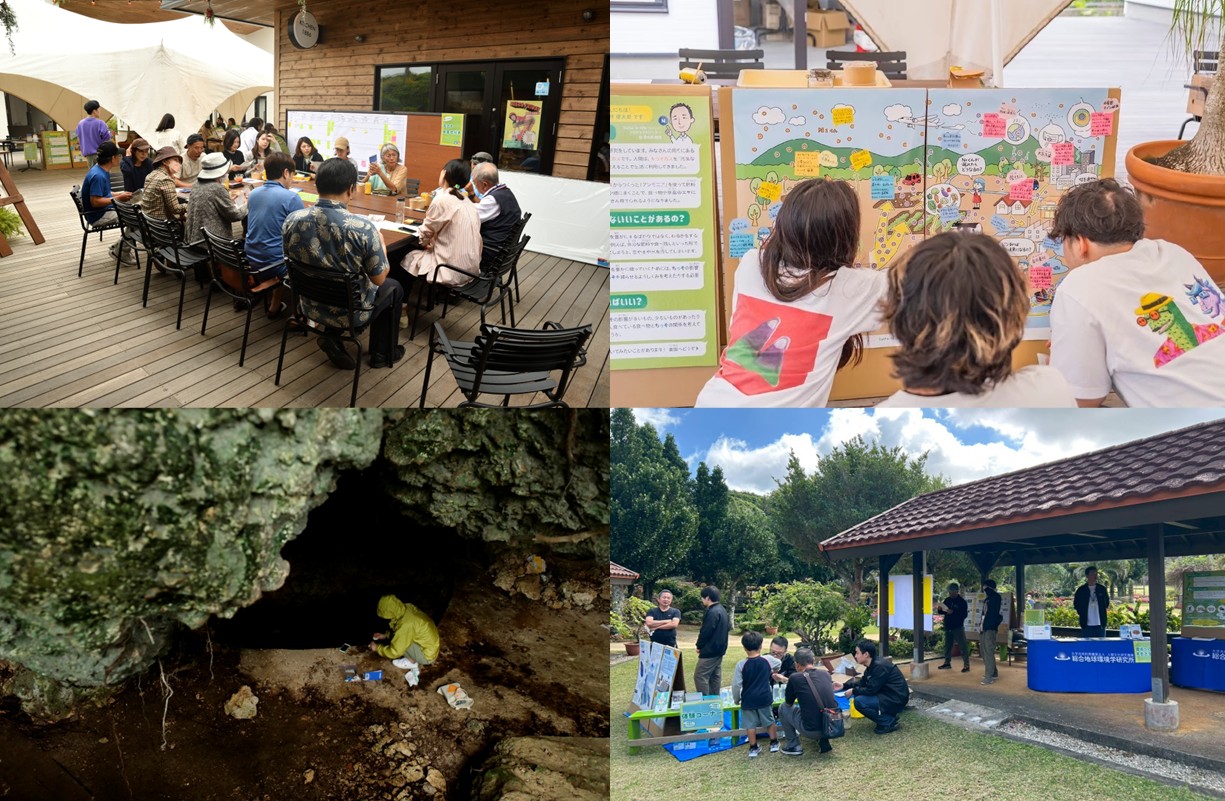
We have been aiming for three breakthroughs to address the nitrogen issue (Figure 2): developing tools to quantitatively analyze the causal links between nitrogen use and pollution; raising awareness of the nitrogen issue; and future design for sustainable nitrogen use. In FY2025 (FR3), we continued to analyze nitrogen cycling in both natural and human systems. On Miyako Island, for example, we conducted groundwater surveys, assessed nitrogen flows, and co-organized a local festival with community groups (Photo 1). We also carried out extensive outreach activities using leaflets (Figure 3) and videos to communicate the nitrogen issue, developed a board game to make nitrogen more relatable, and actively supported domestic and international initiatives on nitrogen management.
Noteworthy items
We contributed to international nitrogen management through roles such as Director of the East Asia Center of the International Nitrogen Initiative (INI) and Steering Committee Member of the Global Partnership on Nutrient Management (GPNM), including participation in the UNEP Working Group on Nitrogen (WGN). Through the project’s contribution to the formulation of Japan’s Action Plan on Sustainable Nitrogen Management, released in autumn 2024 by the Ministry of the Environment in collaboration with relevant ministries, we continued to support discussions on nitrogen management at the municipal scale. Following the successful bid to host the 10th International Nitrogen Conference (N2026) in Kyoto (November 2026; https://n2026.org/), we have been advancing preparations under the main theme, “Sustainable Nitrogen Management for Future Generations.”
Member
Researchers and Research Associates at RIHN
SAIKI Makoto (Researcher)
ARAI Hirotsugu (Researcher)
KIMURA Ayako (Research Associate)
SASAKI Noriko (Research Associate)
Main Members
KOBA Keisuke (Kyoto University)
MATSUBAE Kazuyo (Tohoku University)
KURIYAMA Koichi (Kyoto University)
Evaluation by an external evaluation committee
Research schedule
| 2021 | 2022 | 2023 | 2024 | 2025 | 2026 | 2027 |
|---|---|---|---|---|---|---|
| FS | PR | FR1 | FR2 | FR3 | FR4 | FR5 |