Co-creation of the Earth-human System Program
WEDiDEA Project
A World Ecology of Disasters in Development in East Asia: Integrating Values into Decision-Making by Shifting Worldviews
Abstract
Governing disasters, such as floods or industrial accidents, is central to achieving sustainable development in East Asia. Across the region, the character and risks of disasters have changed due to industrialization and its legacies, trade, investment, aid, and geopolitics. This research will rethink how we understand, prepare for and respond to disasters through examining the interconnections created by East Asian regionalism and peoples’ changing relationship with nature. We focus on cases in Cambodia, Indonesia, Japan, Myanmar, Nepal, the Philippines, and Thailand and the regional economic, environmental and disaster governance systems that impact them.
Why do this research?
The world is confronted with climatic, biophysical and socio-economic challenges that negatively impact the sustainable futures of both humanity and nature. Especially, in a rapidly changing and interlinked world, achieving sustainable development has been increasingly understood as an outcome not only of economic and social policies but also the ability to manage disaster-related risks. Economic connectivity has made increasingly clear ecological connectivities between distant places, and transformed multi-sited local nature-society relations. We seek to understand how thickening economic and ecological connectivities through global commodity chains have led to growing risks and vulnerabilities of disasters, and integrative policy responses. We view disasters as complex socio-economic phenomena that emerge at the intersection of hazard agents and human social systems. We understand disasters and development not as discrete entities; rather they are producers and products of world-making within the longue duree of capitalism.
The main objective of this research is to reduce the impact of disasters through rethinking development that would integrate multiple values into policies and governance of development, environment, and disasters through shifting knowledge systems, worldviews and values on humanity-in-nature relations. Ways of knowing—i.e., conceptualization of the world—structure political responses; shifting ways of knowing is thus central to policy change. Linear understandings of top-down, fragmented, technical responses to disasters and development reflect a set of narrow understandings of why disasters occur and how we should respond to them.
A growing literature emphasizes that values that conceive of humanity as part of nature are central to addressing the formidable climatic, biophysical and socio-economic challenges we currently face. A major report by the Intergovernmental Science-Policy Platform on Biodiversity and Ecosystem Services (IPBES, 2022), for example, engages with values—e.g., responsibility, reciprocity, and respect for nature—as well as diverse knowledge systems—e.g., situated and indigenous knowledges, which are reflected in worldviews—i.e., diverse ways that humanity conceives and interacts with nature. The IPBES typology of values of nature makes visible otherwise neglected contributions from nature and holds the potential of building common ground across different values held by various stakeholders, from which we seek to deepen a critical engagement with power and political economy that determine whose worldviews, knowledge systems, and values are included or excluded in decision-making.
Our transdisciplinary research engages in ethnographic fieldwork and political economy analysis and discourse analysis, incorporating a range of disasters, from primarily human mediated to primarily force-of-nature events in Cambodia, Indonesia, Japan, Myanmar, Thailand, Nepal, and the Philippines. We will use co-production of knowledge methods to maximize local research ownership and uptake of recommendations, including policy dialogues and workshops.
Results
What we want to do
Overall, we focus on making contributions in three main areas— research, policy, and education. Research goal: we aim to advance theoretical understanding of social-ecological interactions, which provides a common platform of multiple values for policymakers to inform, decide, and design policies and governance. Policy goal: this research seeks to be policy-relevant and transdisciplinary by involving community members, industry representatives, policymakers, and practitioners in the design, implementation, and evaluation of research in all of our case studies. Educational goal: this research intends to influence how sustainability is taught in universities by collaborating with scholars and educators and to build a next generation of researchers and policymakers through engagement with research networks.
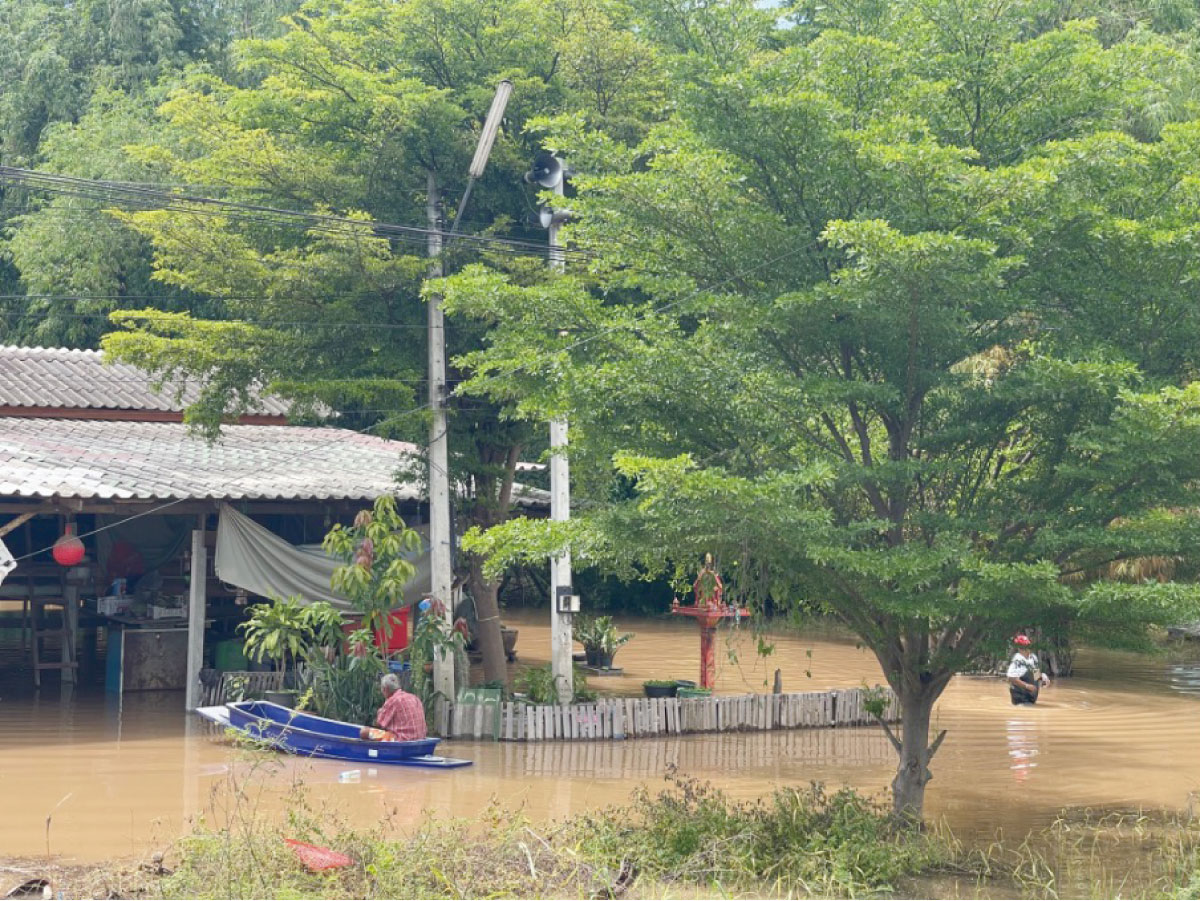
Japan’s investment into Thailand catalyzed wide-spread industrialization. In Ayutthaya, one of Thailand’s industrialization centers, the policy of keeping industrial zones dry made the nearby Bang Ban farming community vulnerable to floods.
Member
Project Leader
ITO Takeshi
Professor, Faculty of Liberal Arts, Sophia University
Sub Leader
MIDDLETON, Carl (Chulalongkorn University)
Main Members
BISRI, Mizan (Asian Disaster Reduction Center/Kobe University)
CRUZ, Ana Maria (Norwegian University of Science and Technology)
DANIA, Maya (Mae Fah Luang University)
GRUNDY-WARR, Carl (National University of Singapore)
NAW THIRI, May Aye (University of Tokyo)
JUWITASARI, Reni (Mae Fah Luang University)
NAGAMI Kozo (Tohoku University)
NAITO Daisuke (Kyoto University)
HARA Yuta (Tohoku University)
PASCUAL, Unai (Basque Centre for Climate Change)
SUGIHARA Kaoru (Research Institute for Humanity and Nature)
SURIMAS, Thianchai (Thammasat University)
VADDHANAPHUTI, Chaya (Chiang Mai University)
YONG, Ming Li (Singapore University of Social Sciences)
Evaluation by an external evaluation committee
Research schedule
| 2025 | 2026 |
|---|---|
| FS | FS/PR |