
Environmental Traceability Project
Proposal and Verification of the Validity of Isotope Environmental Traceability Methodology in Environmental Studies
Abstract
This project investigated environmental traceability as a key concept for solution of environmental problems. Stable isotope ratios of elements, together with concentrations of elements, can trace the flow of matter and chemicals through the environment, better describe ecosystem structure and conditions, and appraise the chemical profiles of food products. Spatio-temporal variation of multiple isotope ratios can be used to study Earth systems operating at local to global scales. This information can serve as an important decision-making tool for local people considering water, food and environmental security, all of which are fundamental for the sustainability of human society.
We conducted two studies to evaluate the validity of “environmental traceability methodology” for environmental studies: 1) effectiveness of the environmental traceability concept, and 2) applicability to the food traceability. For question 1, we asked of the effective points of the methodology to solve environmental problems using a survey by questionnaire and a workshop among stakeholders. Field research took place in Japan at sites in Ono City, Fukui; Otsuchi Town, Iwate; Saijo City, Ehime; Oshino Village, Yamanashi; the Chikusa river watershed, Hyogo; Lake Biwa and surrounding watershed in Shiga; as well as in the Laguna de Bay and surrounding watershed in the Philippines. Questionnaire results indicated that certain types of stakeholder showed special appreciation for the information obtained from the environmental traceability methodology: a) people who are generally involved in the object of conservation (groundwater or river depending on the study sites); b) people who have high concern about the information obtained from the environmental traceability methodology; and c) people who showed high level of understanding about the explanation of the environmental traceability methodology in the symposium at each study site.
For question 2), we tested if the “environmental traceability” authentication by multi-isotope methods were more effective in communicating production conditions and building trust. We focused on food labels and made a web-based questionnaire online survey (N=10,000) of consumers in Japan, the USA, Germany, China and Thailand. We selected four food items that were previously detected by isotopic analysis to be falsely labeled. We set the sources of label information assured by farmer’s photograph, by government institutions, by producer association, by scientific experts (including in isotopic methods), and by consumer reputation. Results showed that the expert labels based on scientific analysis were highly trusted regardless of food type or country and suggested that expert labels might play an important role as trusted sources of information in the global food system.
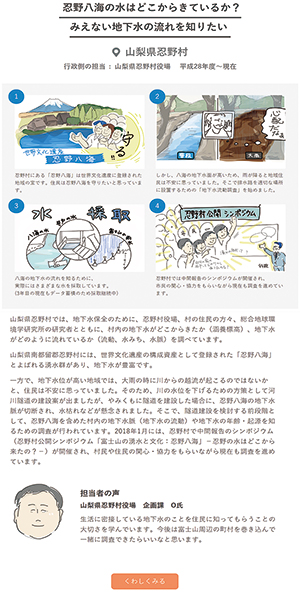
環境トレーサビリティー手法を使っている人と使いたい人を双方向につなぐプラットフォームとしてのウェブサイトを作成し、ポスト・コアプロジェクトで活用する。
Although causal relationships are complicated in global environmental issues, we consider the environmental traceability methodology is valid to tackle environmental issues by sharing scientific information obtained from the methodology with various stakeholders. To disseminate the knowledge and experience, we established an internet website to serve as a platform that shares and develops the environmental traceability methodology. As a transdisciplinary context, we use the results obtained from our project research, and all the finding of Laboratory and Analysis Division in RIHN, including the cooperative research on “Environmental Isotope Study”. The website will continue to connect providers of the environmental traceability methodology with potential users.
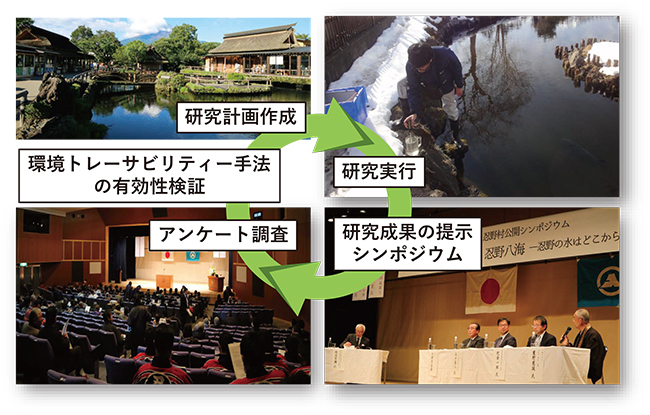
山梨県南都留郡忍野村 忍野村公開シンポジウム(2018年1月20日)
・アンケート集計結果(PDF)
・チラシPDF
兵庫県千種川流域 千種川フォーラム(2018年6月17日)
・アンケート集計結果(PDF)
・質問の回答(PDF)
・チラシPDF
岩手県上閉伊郡大槌町 湧水活用シンポジウム(2018年12月1日)
・アンケート集計結果(PDF)
愛媛県西条市 地下水シンポジウム2019(2019年3月3日)
・アンケート集計結果(PDF)
・チラシPDF
第30回地球研地域連携セミナー(滋賀)(2019年12月22日)
・アンケート集計結果(PDF)
・チラシPDF
忍野村の地下水に関する郵送アンケート調査(山梨県忍野村、2020年2月20日~3月3日)
・アンケート集計結果(PDF)
Member
Project Leader
TAYASU Ichiro