November 28th, 2025
Research News
Health risks of air pollution from stubble burning poorly understood in various parts of Punjab, India
Working Group 3 (WG3) researchers of Aakash project*, Research Institute for Humanity and Nature (RIHN) in Japan and India surveyed 2,202 households in Punjab to examine perceptions of air pollution from stubble burning and its health risks. While many residents recognized severe air pollution in Delhi, fewer acknowledged the impact of local stubble burning on their own health. Households with existing health issues were more aware of the risks. The findings highlight the need for targeted environmental health communication.
In Punjab, India, paddy stubble burning is a widespread agricultural practice that contributes to seasonal air pollution in the region and beyond. However, the extent to which residents recognize its impact on their own environment and health or in the highly populated areas of Delhi National Capital Region (NCR) has remained unclear. To address this gap, the Aakash Project (led by researchers from Hokkaido University in collaboration with Indian research partners) conducted interviews with 2,202 households across 22 districts in Punjab.
Urban air pollution is recognized, but local sources are undervalued
About 46% of respondents perceived air pollution in Delhi as “severe,” while only 25% viewed air pollution in their own areas of Punjab as severe.
Personal health experience increases awareness
Households with family members experiencing respiratory or cardiovascular problems were more
likely to recognize smoke from stubble burning as harmful and to view the practice as a pressing
issue requiring action.
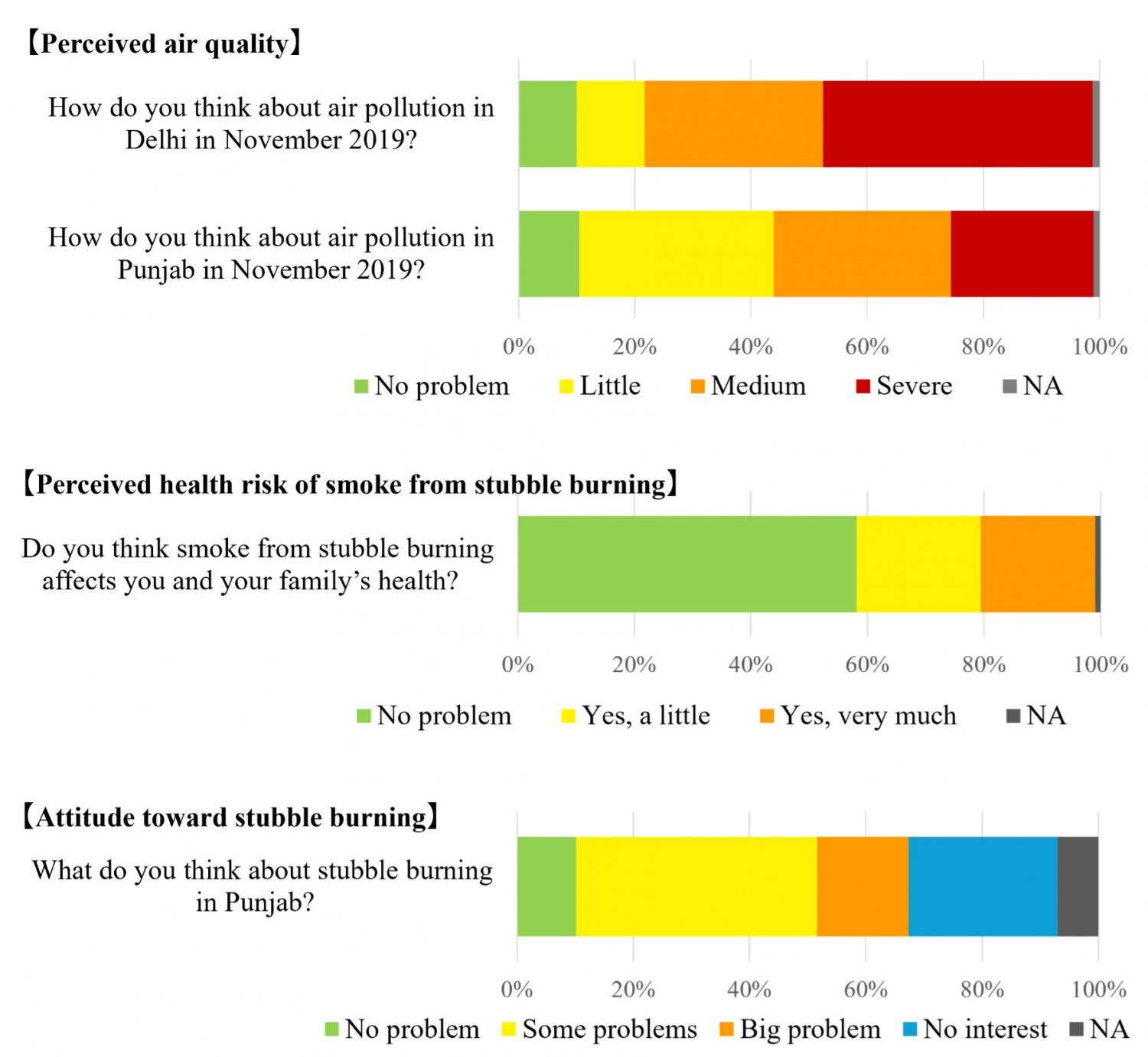 Figure 1. Results of questionnaire asking the perception about air quality and its health risks. While many recognized severe air pollution in Delhi, fewer viewed local air quality as severe. Most households believed that smoke from stubble burning did not affect their health, even though many agreed that the practice is a major issue.
The study reveals a perception gap: while urban air pollution is widely acknowledged, the contribution of locally generated smoke from stubble burning remains less recognized. Personal or familial health experiences and health literacy play a crucial role in shaping awareness. These insights suggest that efforts to reduce stubble burning and improve air quality must include clear, locally grounded communication on health impacts, supported by accessible and visible air quality information.
*The Aakash project is exploring ways to shift people's behaviour to sustainable agriculture in the Punjab region to reduce the health hazards caused by air pollution, by clarifying observation-based relationship between straw burning and local air pollution; raising awareness of the importance of maintaining clean air among residents; and proposing the effective and beneficial use of rice straw by farmers.
Article information
Title: Perceptions of air pollution from stubble burning and its health risks in Punjab, India
Journal:Scientific Reports
Authors: Zhesi Yang, Kayo Ueda, Tomohiro Umemura, Kazunari Onishi, Hiroaki Terasaki, Tomoki
Nakayama, Yutaka Matsumi, Kamal Vatta, Hikaru Araki, Sachiko Hayashida, Prabir K Patra
Article Publication Date: October 27, 2025
URL: https://doi.org/10.1038/s41598-025-21235-8
Contacts
Mayuko Kataoka
PR Unit, Research Institute for Humanity and Nature
E-mail: kikaku[at]chikyu.ac.jp
Office: 81-(0)75-707-2128