November 22nd, 2023
Research News
The northwest India gets a respite from high PM2.5 due to rainfall on 10th Nov 2023 but the regional PM2.5 behaviour changed within 2 days
The post-monsoon season gives ideal circumstances for air pollution to develop in the northwest India, as discussed in our previous reports. On the same pane, when Diwali festival was to approach, Delhi braced itself for the worse air quality but the Goddesses of the holy festival had other ideas. To track the situation of air pollution, the Aakash Project at RIHN is conducting an intense field campaign to measure PM2.5 in and around northwest India (https://aakash-rihn.org/en/data-set/). We previously reported on the fast growth in PM2.5 and CO levels in RIHN news, episode 1, subsequent control by emission mitigation policy in RIHN news, episode 2 based on real-time measurements and analysis in the states of Punjab, Haryana and Delhi NCR.
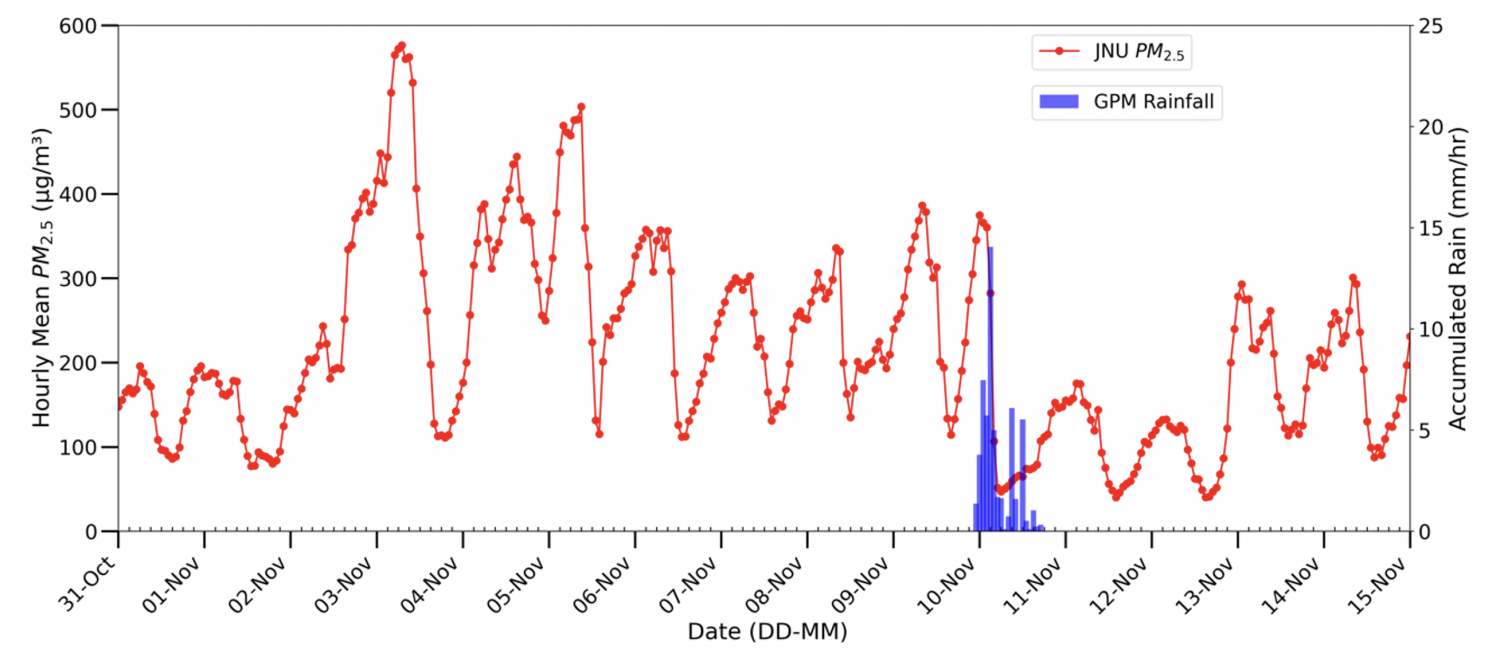
In this 3rd edition we discuss the dramatic changes in the PM2.5 and associated air pollutants in Punjab, Haryana and Delhi-NCR on 10 Nov 2023. The GRAP Stage III was implemented in Delhi-NCR on 02 Nov and Stage IV was enacted on 05 Nov (CAQM, 2023), following which our measurements also showed a stabilization of PM2.5 at daily mean of about 300 µg m–3 during 3-4 Nov and a decrease in PM2.5 during 5-8 Nov to about 200 µg m–3 (Figure 1). However, the precipitation events on 10 Nov resulted in steepest decrease in PM2.5 to daily mean of about 50–60 µg m–3 in the Delhi-NCR. The unexpected decline on 10 Nov must have been a consequence of wet removal of particulate matters by rainfall. This event occurred just about the time when the governments were contemplating artificial rain to clean up the air (ET, 8 Nov 2023).
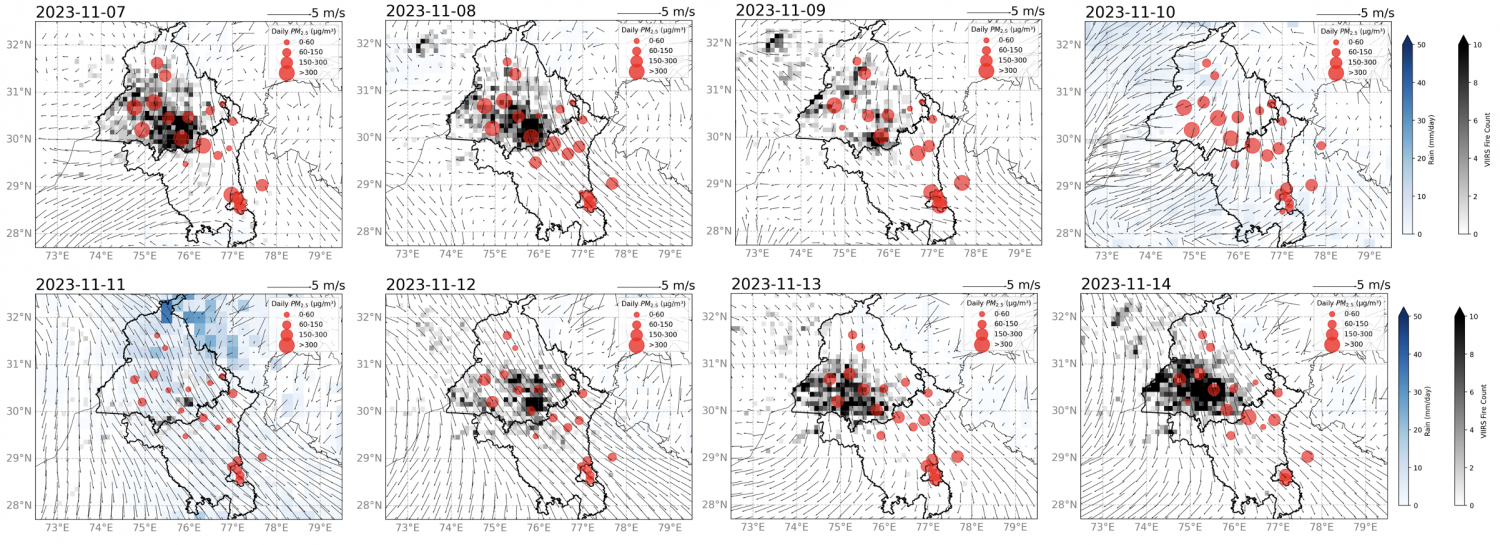
Due to the rainfall and possibly the obscuring clouds overhead, there were fewer fires detected on 10-11 Nov in the northwest India region (Figure 2). In order to provide a comprehensive picture of the progression of PM2.5 pollution, we have depicted maps of fire counts, rainfall and wind vectors during 7–14 Nov (Figure 2). Up to 9 Nov, the majority of the station had daily mean PM2.5 concentrations between 300 and 400 µg m–3, with a drop in the number of fires reported on that day. Following the precipitation on 10-11 Nov, the fire hotspots vanished and PM2.5 levels in Punjab and Haryana also dropped to less than 60 µg m–3 at a few of our CUPI-G sites. On 12 Nov, the fire counts begin to intensify, and on 14 Nov, the concentration rises back to more than 150 µg m–3.
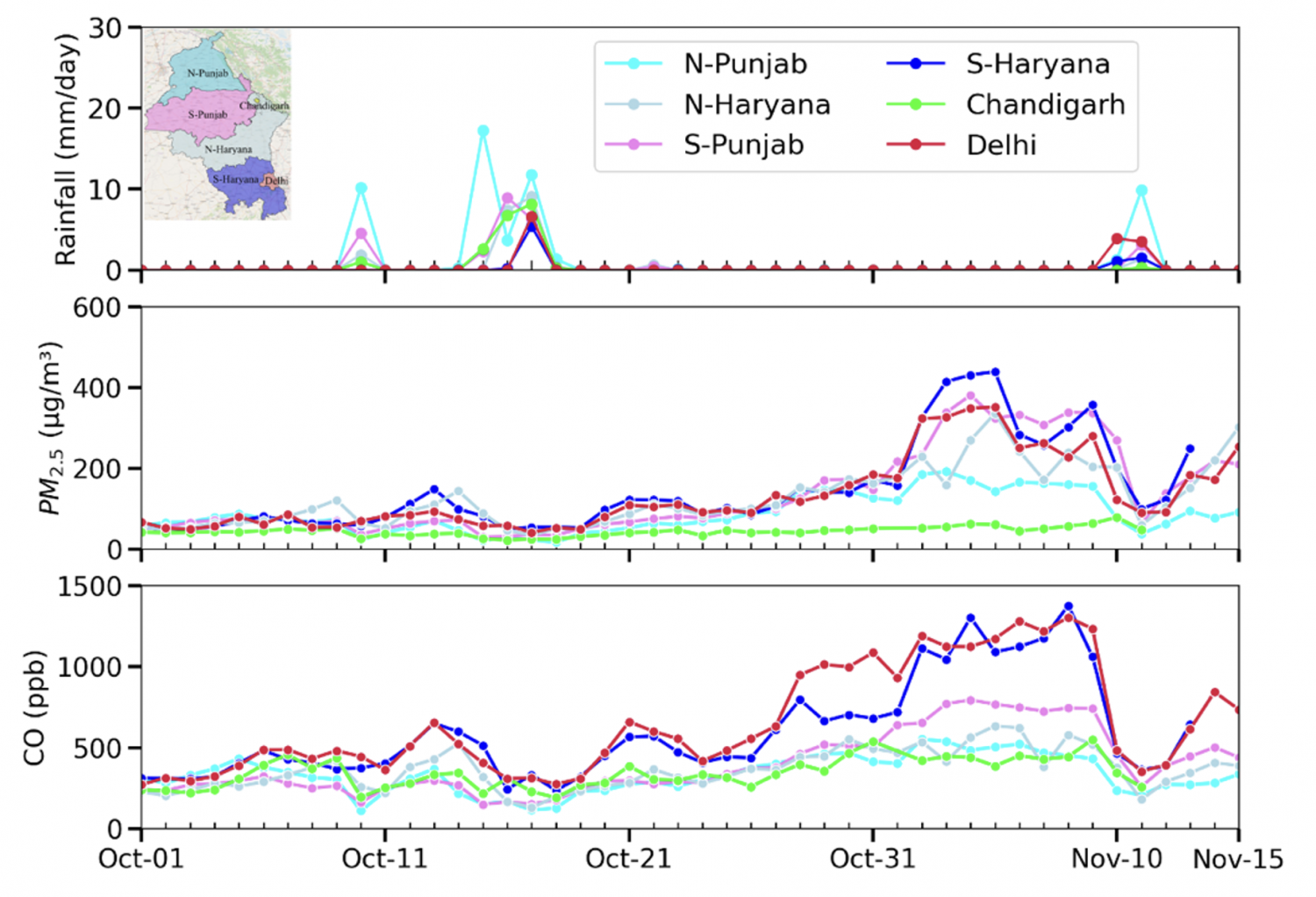
To summarise all our CUPI-G measurements of PM2.5 in association of with the rainfall events, we have further segregated the northwest domain to six regions comprising North-Punjab, South-Punjab, Chandigarh, North-Haryana, South-Haryana & Delhi (Figure 3). The PM2.5 and CO values increased steadily after about 18 Oct for all the regions, except in the city of Chandigarh, where the local traffic is better organised and infrastructure development is not drastic. All other regions come under a common environmental condition of post-monsoon season in semi-arid region and surrounded by agriculture dominated activities. Surprisingly, the build-up of CO during 26 Oct to 9 Nov is seen only for south Haryana and Delhi regions, while the PM2.5 were high for whole Haryana, south Punjab and to some extent north Punjab, and Delhi (Figure 3). Since CO is a longer lived gaseous species compare to PM2.5 we would expect more uniform CO levels in the region if biomass burning related emissions were driving the regional air pollution.
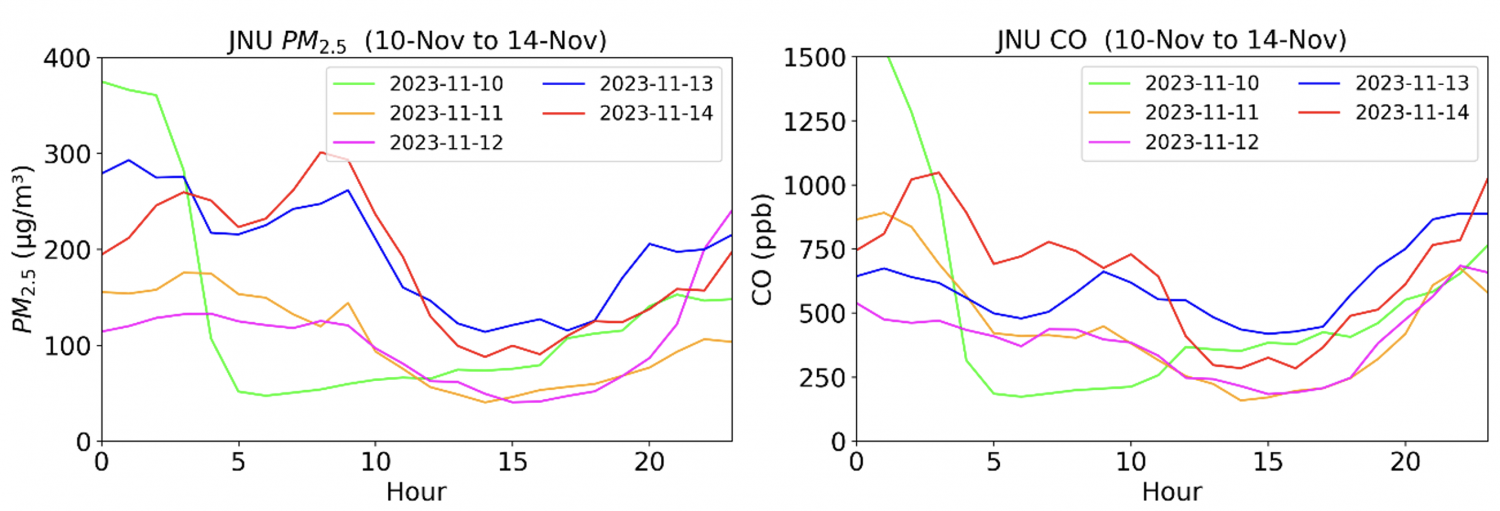
Given the decrease in PM2.5 concentrations over Delhi on 10 Nov, we investigated the diurnal variation in PM2.5 and CO at JNU (Figure 4). The diurnal profile of PM2.5 also revealed a sharp decline around early morning. When we look into the days altogether from 10-14 Nov. The days of 13-14 Nov represent typical diurnal variation of PM2.5 in Delhi NCR, where an early morning peak at around 9 AM local time is formed due to vehicular emissions by the office goers, followed by a decrease when the material mixing height is raised during the mid-day. Our atmosphere disperse (accumulate) freshly emitted air pollutants from earth’s surface depending high (low) winds speed and high (low) mixing height during the day (night). The hourly GPM data reveals that most rainfall (~15 mm/hr) occurred around 3-4 AM on 10 Nov in Delhi, bringing the PM2.5 concentration down immediately to as low as 50-60 µgm-3. Although Delhi had adequate rainfall on the 10 Nov, prior to Diwali on 12 Nov, the PM2.5 concentration rose sharply after 8 PM on 12 Nov providing a vivid image of the effects of Diwali firecracker burning on air pollution. The Diwali and weekend holidays effect is also reflected by the missing early morning peak PM2.5 on 11-12 Nov compared to other days (13-14 Nov).
Reference
RIHN news, episode 1, Very high air pollution event on 2-5 Nov 2023 in Delhi NCR couldn’t be explained by crop residue burning. 08 November 2023; www.chikyu.ac.jp/rihn_e/news/detail/410/
RIHN news, episode 2, Government policy to decrease major emission sources led to reduction in PM2.5 in the Delhi NCR during 4-9 November 2023. 14 November 2023; https://www.chikyu.ac.jp/rihn_e/news/detail/414/
Commission for Air Quality Management (CAQM). Implementation of Actions under Stage-IV (severe plus Air Quality) of revised Graded Response Action Plan in Delhi-NCR, 5th Nov 2023; https://caqm.nic.in/index1.aspx?lsid=4168&lev=2&lid=4171&langid=1.
The Economic Times (ET), 08 Nov 2023; https://economictimes.indiatimes.com/news/india/delhi-air-pollution-govt-mulls-idea-of-artificial-rain-by-nov-20-says-minister-gopal-rai/videoshow/105075455.cms?from=mdr
Takigawa, M. P. K. Patra, Y. Matsumi, S. K. Dhaka, T. Nakayama, K. Yamaji, M. Kajino, S. Hayashida, Can Delhi’s pollution be affected by crop fires in the Punjab region? SOLA 16, 86–91 (2020). https://doi.org/10.2151/sola.2020-015