Feasibility Study
Co-creation of the Earth-human System Program
Water and Nutrient Footprint Analysis from Land to Ocean and Its daptation Strategies for Tipping Points: Towards Healthy Coastal Areas in Asia
Abstract
Coastal waters in Asian countries face various environmental issues—such as eutrophication, oligotrophication, and hypoxia—depending on the stage of economic development. This project focuses on the transport of water and nutrients from land to sea, identifying historical turning points and understanding environmental impacts. By integrating future projections and socio-economic benefit analysis, we propose sustainable management strategies adapted to each region’s characteristics.
Why do this research?
Rapid economic growth and population concentration in many Asian coastal regions have created environmental challenges such as eutrophication, oligotrophication, hypoxia, and declining fish catches. Japan experienced similar problems during its rapid-growth era but recovered through strict environmental regulations. Recently, however, some coastal waters have become “too clean,” which may now contribute to reduced fishery productivity. These long-term changes indicate the presence of key turning points shaped by interactions between society and climate.
This project investigates these environmental transitions to help realize “healthy coastal waters.” By examining global drivers like climate change together with region-specific factors such as land use and social conditions, we develop adaptation strategies tailored to local contexts.
Focusing on nutrients transported from land to sea, we analyze regional water and nutrient footprints, assess current conditions, and project future changes under multiple climate scenarios. Based on these findings, the project proposes practical strategies for the sustainable use of water and nutrients that support resilient coastal ecosystems and communities.
What we want to do
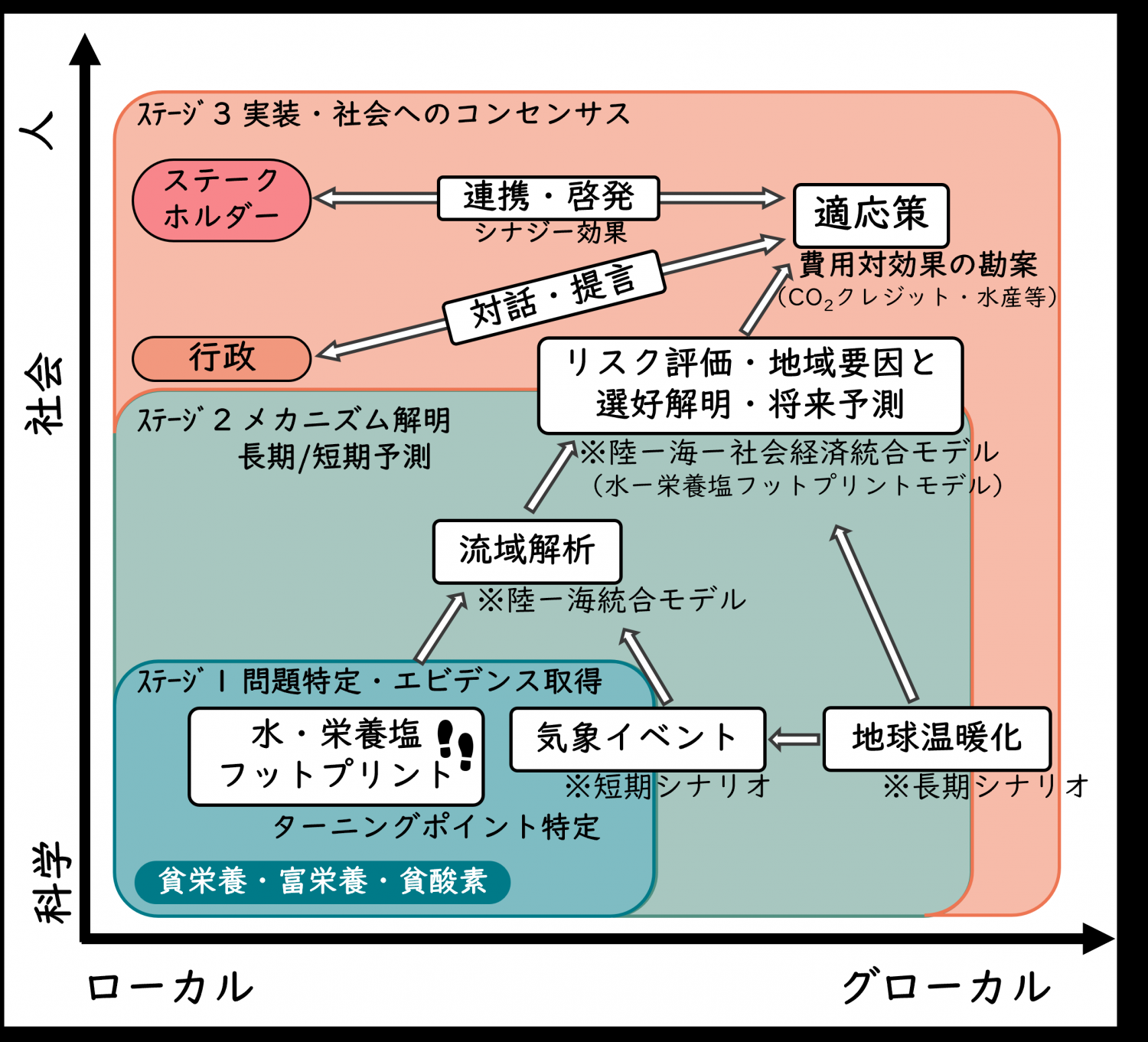
This project is organized into three stages:
(1) identifying issues and gathering evidence,
(2) analyzing mechanisms and developing long- and shortterm projections, and
(3) promoting social implementation and building societal consensus.
We begin by visualizing the water and nutrient footprints that link land and sea. In the target coastal areas, we assess current environmental conditions, identify the origins and key elements of emerging problems, and classify them into patterns. By integrating water and nutrient monitoring data with regional socioeconomic data, we quantitatively evaluate social costs and benefits. Based on insights gained through collaboration with diverse stakeholders, we also examine measures to enhance ecosystem services and explore improvements to existing policies and the development of new ones, aiming to design comprehensive adaptation strategies.
In Japan, we analyze long-term monitoring records to understand past turning points in coastal environments. In Southeast Asia, we introduce Japan’s past best practices—such as overcoming pollution—and begin capacity-building tailored to local needs. Led by the Japanese research team, we work with partners across government, industry, and academia to improve recognition and understanding of the issues and to identify pathways toward practical implementation.
Through these efforts, the project aims to contribute to the realization of “healthy coastal waters” in both Japan and Southeast Asia.
Figure 1 Overview of the project
News
-
{{ data.disp_date }}
{{ data.content }}
Member
FS Principal Investigator
ZHANG Jing
Vice President for International Affairs and Professor, Faculty of Science, University of Toyama
Main Members
GUO, Xinyu Ehime University
MORIMOTO Akihiko Ehime University
TEBAKARI Taichi Chuo University
MATSUURA Takuya University of Yamanashi
KOBAYASHI Hideki University of Toyama
ENDO Takahiro Osaka Metropolitan University
YANG, Jie Shinshu University
CHAKRABORTY, Shamik University of Toyama
YAMAGUCHI Atsuko Nagasaki University
INAMURA Osamu INAZ-Lab, Former Director of Uozu Aquarium
MATSUNO Takeshi Professor Emeritus, Kyushu University